
From Active Observation to Pure, Formless Presence
Three stages of Recognition
🧘♀️ Stage 1: Recognizing Awareness Through Active Investigation
The journey of meditation begins with an intentional turning inward. At this first stage, the practitioner takes the role of an active observer, consciously investigating what awareness is.
The observer looks back toward itself with curiosity and clarity, asking what it is that enables knowing. Through this investigation, it becomes evident that awareness is that which cognizes all experience.
It is awareness that allows sensory input to be known: sights, sounds, bodily sensations, and spatial orientation. At the same time, it is awareness that recognizes internal phenomena such as thoughts, emotions, memories, and moods.
The practitioner begins to see that every experience—outer or inner—appears within awareness. Thoughts arise, remain for a moment, and dissolve, yet awareness remains present throughout.
Feelings fluctuate, emotions surge and fade, but awareness continues unchanged. At this stage, the observer is still actively analyzing and conceptualizing awareness. There is a subtle sense of “I am looking at awareness.”
This investigation is necessary, as it establishes a clear experiential distinction between awareness and its contents. The practitioner realizes that awareness is not an object but the condition that allows all objects to be known. This recognition lays the foundation for all deeper stages. Without this clarity, the journey cannot proceed.
🧘♀️ Stage 2: Discovering the Constancy of Awareness Beyond Thought
In the second stage, the active observer continues to look into awareness, but the mind begins to quiet naturally.
Thoughts, emotions, and mental activity gradually subside without force or suppression. As conceptual activity diminishes, the practitioner notices something crucial. Even when thoughts disappear, awareness does not disappear with them. Even when emotions fall silent, awareness remains fully present.
There is a direct realization that awareness does not arise and vanish like thoughts do. It does not fluctuate, fade, or dissolve when the mind becomes still. Awareness reveals itself as constant, continuous, and unavoidable.
The practitioner discovers that awareness cannot be turned off or interrupted. There is no gap where awareness ceases to exist. This realization marks a profound shift in understanding.
Awareness is now seen as fundamentally different from thoughts and emotions in its mode of being.
It does not behave like mental phenomena; it does not come and go. The observer still remains present, but now with less effort and less conceptual activity. Awareness stands out clearly as the stable background of all experience.
🧘♀️ Stage 3: Forgetting the Looker and Uncovering Pure Awareness
In the third stage, the final and most subtle veil must be addressed. Although thoughts and emotions have subsided, there is still a subtle sense of a watcher.
There remains an observer that is passively looking, monitoring, or witnessing awareness.
This observer, though refined, is still a form of conceptualization. To go deeper, this looker must be forgotten entirely. Not analyzed, not refined—but released. The practitioner lets go of the one who is looking.
There is no longer an attempt to understand awareness or relate to it. The act of observation itself dissolves.
When the looker disappears, awareness remains fully present. This reveals that awareness never required an observer in the first place. Awareness stands on its own, uncovered and self-existing.
There is no subject-object relationship left. Experience becomes contentless, silent, and deeply still. Awareness remains as pure presence, beyond words, concepts, or investigation.
🧘♀️ Conclusion: Resting as Uncovered Awareness
The meditative journey unfolds as a gradual relinquishing of effort and identity. It begins with active investigation and clear recognition.
It deepens through the discovery of awareness as constant and unchanging. It culminates in the complete forgetting of the observer.
What remains is not a state created by practice, but what was always present. Awareness reveals itself as timeless, stable, and independent of mental activity.
There is nothing left to observe and no one left to observe it. Only awareness remains—silent, contentless, and whole. This is not an experience among experiences. It is the ground of all experience.
Here, meditation ends not in effort, but in rest. Not in knowledge, but in direct being. Awareness stands free of all coverings.
Nothing is added. Nothing is removed.
🧘♀️ Comment: The Essence and Beyond
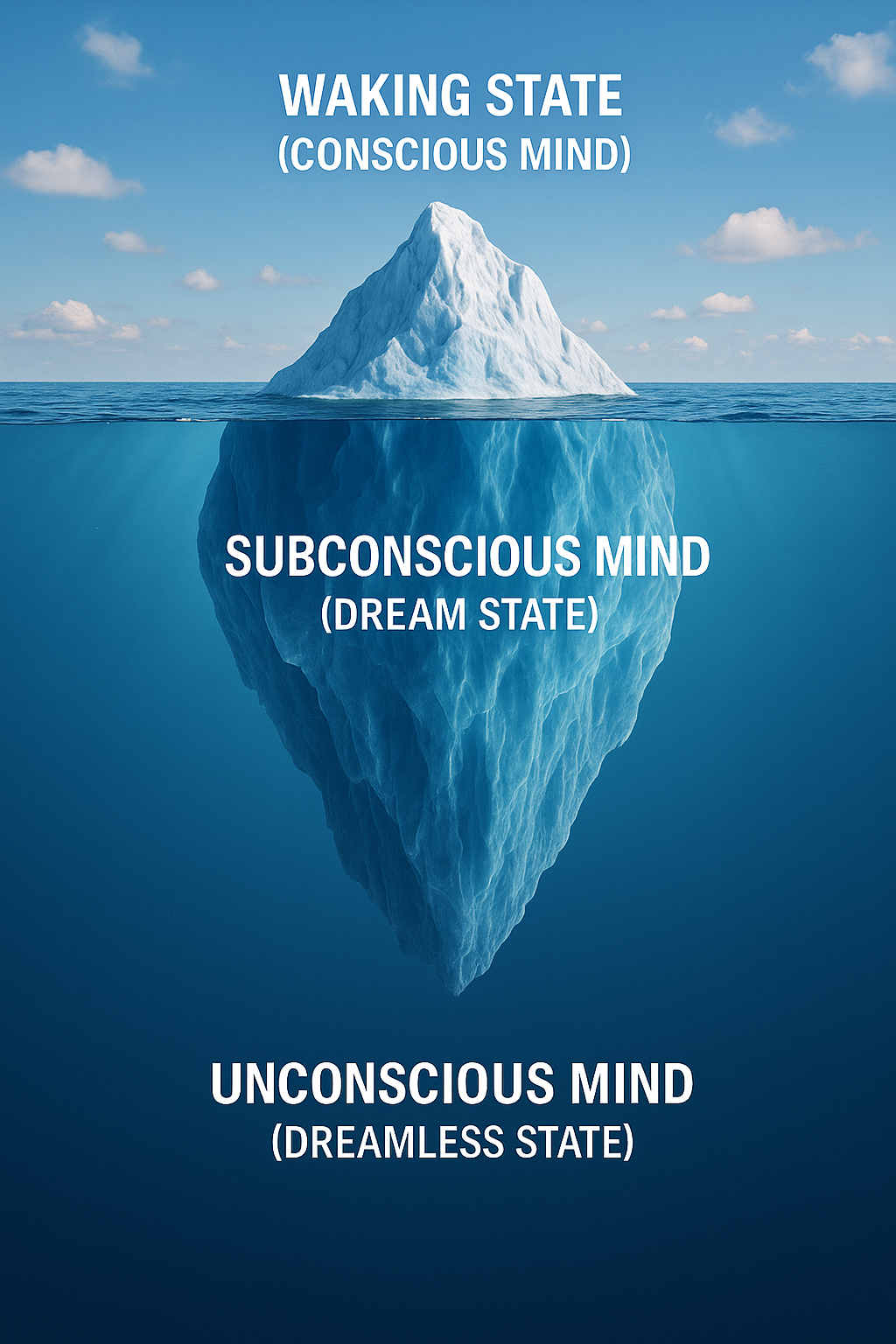
The essence of these three stages is to calm the thoughts, the feelings, and the emotions, allowing the practitioner to dive deep within themselves into dreamless sleep.
In this profound state, naked awareness is recognized as constant and ever-present “clear light” (unbound and universal awareness), unaffected by the fluctuations of thought and emotion.
From this deep recognition, the journey progresses into the next phase of internal development, engaging with the 8 stages of sleep dissolution.
These stages build upon one another, guiding the practitioner deeper into the essence of awareness and the profound nature of the mind.

🌿 Emotional Transformation - step by step
- A. Pause and scan: “Notice where this emotion lives in your body—what’s the tone, texture, temperature?”
- B: Witness the energy: “Pause. Breathe into it. Observe its motion—urging, contracting, expanding.”
- C. Redirect or dissipate: “Anchor in your breath or posture. Let the energy spread, slow, soften.”
- D. Rest at the chest level: "Bring the emotional energy to dissolution free from judgement and opinion."

 EN
EN  DA
DA  VI
VI  FR
FR  DE
DE